
Total 713 Questions |
Updated On: May 22, 2026
Start Your Succesful IT Certification Journey With 3 Easy Steps!

1
DOWNLOAD PDF QUESTIONS
- Experience Complete Access to Practice Exam Questions
- Obtain Genuine Dumps PDF Questions
- Access a Free Questions Demo
- Receive Complimentary Updates for 90 Days

2
PRACTICE SESSIONS ONLINE
- Free IT Exam Practice Online
- Diverse Question Sets
- Convenient Browser-Based Test Platform
- Instant Access, No Installation Needed

3
SUCCESSFUL OUTCOME
- Efficient Exam Preparation
- Achieve High Grades
- Success Assured
- Kickstart a Brilliant Professional Career
100% Free CFA Institute CFA-Level-II Practice Test Questions and Answers 2026
Start Learning with the Latest and Real 100% Free CFA Institute CFA-Level-II Exam Questions
Page: 1
/ 143
Question 1
Chris Darin, CFA, works as a sell-side senior analyst and vice president for a large Toronto brokerage firm researching mainly hedge funds and alternative investments. Darin recently hired Simon Nielsen for the position of junior analyst at the firm. Although Nielsen does not have experience evaluating hedge funds, Darin hired him mainly for his previous experience at a discount brokerage firm and for his passion for the industry. Darin frequently mentors Nielsen on market trends, investment styles, and on risks inherent in alternative investment vehicles. In a recent conversation, Darin makes the following statements:Statement 1: One way to measure hedge fund investment performance is through Jensen's alpha. A portfolio with negative Jensen's alpha would plot above the Security Market Line (SML).Statement 2: Both the Sharpe ratio and Jensen's alpha can be used to measure risk-adjusted hedge fund returns. Oneof the advantages is comparability between the two methods since both calculate return relative to systematic risk.Their conversation later shifts to discussing hedge fund classifications and how derivatives affect hedge fund performance measurement. Nielsen mentions that put options are often more advantageous than short selling in a market neutral strategy because of their asymmetric returns.The following week Darin asks Nielsen to research potential problems and biases in hedge fund indexes and general risks inherent in investing in hedge funds. Nielsen compiles the information and presents the following findings:1. One of the data problems in hedge fund indexes is that managers often do not disclose negative fund performance.2. The historical performance of hedge funds that are recently added to an index is often added to the past performance of the index.3. Long/short equity hedge funds are subject to equity market risk. This risk is typically greater than with equity market neutral or risk arbitrage funds due to the higher standard deviations and market correlations inherent in long/short funds.4. Fixed income arbitrage funds are also subject to equity market risk. These funds are short Treasuries and long high-credit-risk bonds. In an economic downturn the short position in Treasuries provides a buffer against the long position and provides a net gain.Finally, the two discuss the risk-free rate and various risk measures in hedge fund performance evaluation. Darin explains that even in market neutral strategies, the risk-free rate may not be an appropriate measure of fund performance. Nielsen does not understand and asks him to clarify. Darin further states that risk measures such as Value at Risk have several limitations as a risk measurement tool.Nielsen's findings on long/short equity funds and fixed income arbitrage strategies, respectively, are:
Answer: C
Question 2
Frank Hoskins and Paul Lanning are economists for a large U .S . investment advisory firm. Platinum Advisors. Hoskins and Lanning use their independent research on U .S . stocks and international stocks to provide advice for the firm's network of advisors. As the senior economist at Platinum, Hoskins is a partner in the firm and is Lanning's supervisor. Lanning has worked for Platinum for the past four years. At a lunch meeting, the two economists discuss the usefulness of economic theory, economic data, and the resulting forecasts of the global economic and stock market activity.Hoskins is investigating the growth prospects of the country of Maldavia. Maldavia is a formerly communist country with a population of 3 million located in Eastern Europe. The Maldavian government had been aggressive in instituting political reform and encouraging the growth of financial markets. However, due to a recent insider trading scandal and resulting stock market volatility, the Maldavian government is considering restrictions on further stock market growth and the establishment of a national securities regulator. Hoskins states that these developments are not encouraging for future economic growth.Lanning is examining the country of Petra. Petra is a country of 25 million located in South America and rich with natural resources including oil. The recently elected president of Petra, Carlos Basile, has announced that he would like to diversify the country's economy away from natural resources while nationalizing the oil industry. Lanning states that these changes would not be beneficial for the future growth of the Petrian economy.One of the many items they study when examining an economy or stock market is the economic information released by governments and private organizations. Hoskins and Lanning use this information to determine the effects on economic growth and the appropriate portfolio allocations to the bond and stock markets. Examining information for Maldavia, Hoskins has learned that the Maldavian private sector has embarked on an ambitious plan to increase labor productivity by purchasing more machinery for its factories. The private sector feels compelled to do this because Maldavia has historically relied too heavily on labor as the main input into production. Plotting the productivity curve for Maldavia, Hoskins states that labor productivity should increase because the productivity curve will shift upward and to the right.Lanning is examining the historical record of economic growth in Petra. He has gathered the data in Exhibit 1 to determine potential economic growth. Hoskins is also examining data for the country of Semeria. Semeria is an emerging country that has benefited from recent changes in the political environment as well as technological advances. Its economy is growing rapidly, and changes in the Semerian economy and society have resulted in more opportunities for women. The Semerian economy has experienced 17 consecutive quarters of positive growth in GDP, which is unprecedented in Semerian history. Interest rates have increased over time because businesses have been borrowing heavily to invest in new machinery and technologies. Most economists are forecasting further increases in interest rates in Semeria.It has long been Platinum's policy that its economists use long-term economic growth trends to forecast future economic growth, stock returns, and dividends in a country. Lanning is examining the economy of Tiberia. Tiberia has a population of 11 million and is located in northern Africa. Its economy is diversified, and its main exports are agricultural products and heavy machinery. The country's economy has been growing at an annual rate of 6.2% for the past ten years, in part because of technological advances in the manufacture of heavy equipment. These advances involve the use of computer-operated welding machines that have made the manufacture of heavy equipment less expensive. Lanning is worried, however, that the 6.2% GDP growth rate may not be sustainable and is considering advising Platinum's portfolio managers to decrease their portfolio allocations in the country. Before doing so, he will consult with Hoskins.Are the statements made by Hoskins and Lanning regarding the future growth of the Maldavian and Petrian economies likely to be correct or incorrect?
Answer: A
Question 3
Yummy Doughnuts (YD) sells a variety of doughnuts and other related items through both company-owned locations and franchise locations. YD has experienced significant growth over the past five years. However, barriers to entry are low and competition is increasing.Linda Haas, CFA, follows YD for Gibraltar Capital. Gibraltar Capital prides itself on its thorough fundamental analysis of investment opportunities. The company uses a bottom-up approach to the investment process. Haas's security selection process utilizes residual income models to determine a stock's intrinsic value. Haas obtains YD's 2008 financial statements shown in Exhibit 1. In addition, Haas provides supporting information about YD's financials and other related material found in Exhibit 2.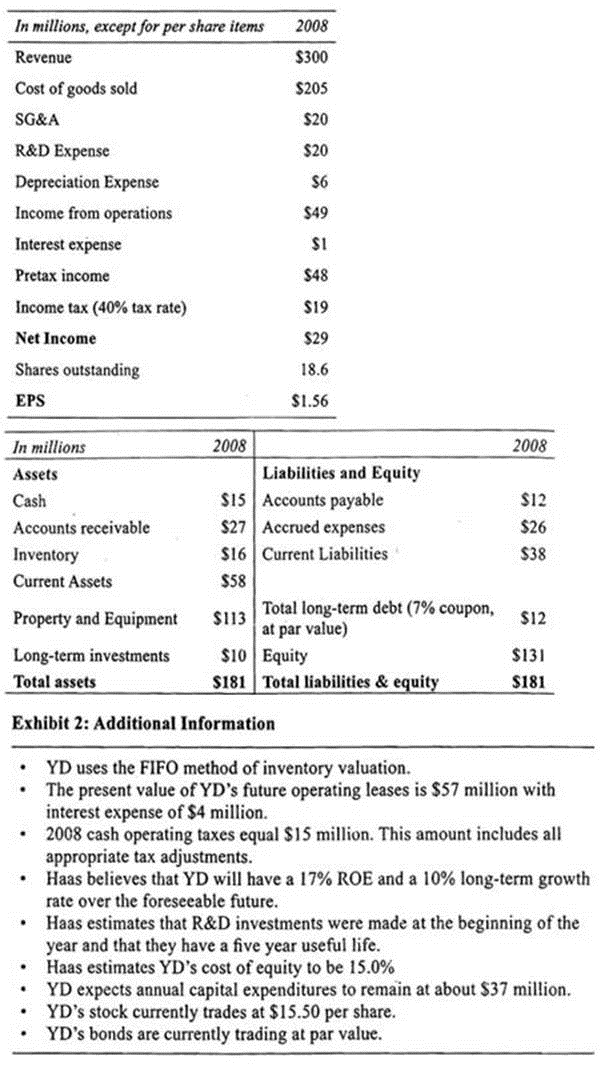 Haas makes the following statements during her YD presentation to the investment committee.Statement 1: Based on ROE mean reversion, YD's continuing residual income is assumed to decline to zero over time.Statement 2: The residual income model states that if YD's ROE equals its equity cost of capital, then YD's intrinsic value will equal its book value per share.Haas notes that the multi-stage residual equity income model captures more detail in calculating YD's intrinsic value. An assumption of the model is that ROE fades to the cost of equity over time, which is known as a persistence factor (varying from 0 to 1). Identify which characteristic indicates a higher persistence of abnormal earnings.
Answer: A
Question 4
Mary Pierce, CFA, has just joined The James Group as a fixed income security analyst. Pierce has taken over for Katy Williams, who left The James Group to start her own investment firm. Pierce has been reviewing Williams's files, which include data on a number of securities that Williams had been reviewing.The first file had information on several different asset-backed securities. A summary schedule that Williams had prepared is shown in Exhibit 1.Exhibit 1: Summary Schedule The second file included the following schedule of information relating to a specific CMO thai Williams had been considering. Exhibit 2 reflects the results of a Monte Carlo simulation based on 15% volatility of interest rates. This security is stil! available, and Pierce needs to evaluate the investment merit of any or all of the listed tranches.
 A third file contained notes Williams had laken at a seminar a couple of months ago on valuing various types of asset-backed and mortgage-backed securities. These notes included the following comments that Pierce found interesting:'Cash flow yield (CFY) is one method of valuing mortgage-backed securities. An advantage of the CFY is that it does not rely on any specific prepayment assumptions. An important weakness of CFY is the assumption that interim cash flows will be reinvested at the CFY. This is rarely true for mortgage-backed securities.''Cash flow duration is similar to effective duration, but its weakness is that it fails to fully account for changes in prepayment rates as cash flow yields change. Empirical duration suffers two disadvantages as a measure of interest rate exposure: reliance on theoretical formulas and reliance on historical pricing data that may not exist for many mortgage-backed securities.''The recent increase in the default rate for subprime adjustable rate mortgages can be traced to the structure of these loans. The negative amortization feature of these loans basically gave the borrower an at-the-money call option on their property. Once the property decreased in value, this call option was worthless, and the borrower had no incentive to make any additional payments.'Pierce realizes that she will need to do a more in-depth analysis, but based only on the information in Williams's CMO table, she can conclude that:
Answer: A
Question 5
Natalia Berg, CFA, has estimated the key rate durations for several maturities in three of her $25 million bond portfolios, as shown in Exhibit 1. At a fixed-income conference in London, Berg hears a presentation by a university professor on the increasing use of the swap rate curve as a benchmark instead of the government bond yield curve. When Berg returns from the conference, she realizes she has left her notes from the presentation on the airplane. However, she is very interested in learning more about whether she should consider using the swap rate curve in her work.As she tries to reconstruct what was said at the conference, she writes down two advantages to using the swap rate curve:Statement 1: The swap rate curve typically has yield quotes at 11 maturities between 2 and 30 years. The U .S . government bond yield curve, however, has fewer on-the-run issues trading at maturities of at least two years.Statement 2: Swap curves across countries are more comparable than government bond curves because they reflect similar levels of credit risk.Berg also estimates the nominal spread, Z-spread, and option-adjusted spread (OAS) for the Steigers Corporation callable bonds in Portfolio 2. The OAS is estimated from a binomial interest rate tree. The results are shown in Exhibit 2.
 Berg determines that to obtain an accurate estimate of the effective duration and effective convexity of a callable bond using a binomial model, the specified change in yield (i.e., Ay) must be equal to the OAS.Berg also observes that the current Treasury bond yield curve is upward sloping. Based on this observation, Berg forecasts that short-term interest rates will increase.If the spot-rate curve experiences a parallel downward shift of 50 basis points:
Answer: A
Page: 1
/ 143
Total 713 Questions |
Updated On: May 22, 2026
© Copyrights TheExamsLabs 2026. All Rights Reserved
We use cookies to ensure your best experience. So we hope you are happy to receive all cookies on the TheExamsLabs.